Orqivo
Neon Framework
Neon Framework
Couldn't load pickup availability
Self-paced learning overview
- 📥 Digital file available after purchase
- 🗂️ Long-term availability
- 🔒 Secure checkout
- 🗓️ Content updated in 2026
1. Problem Statement
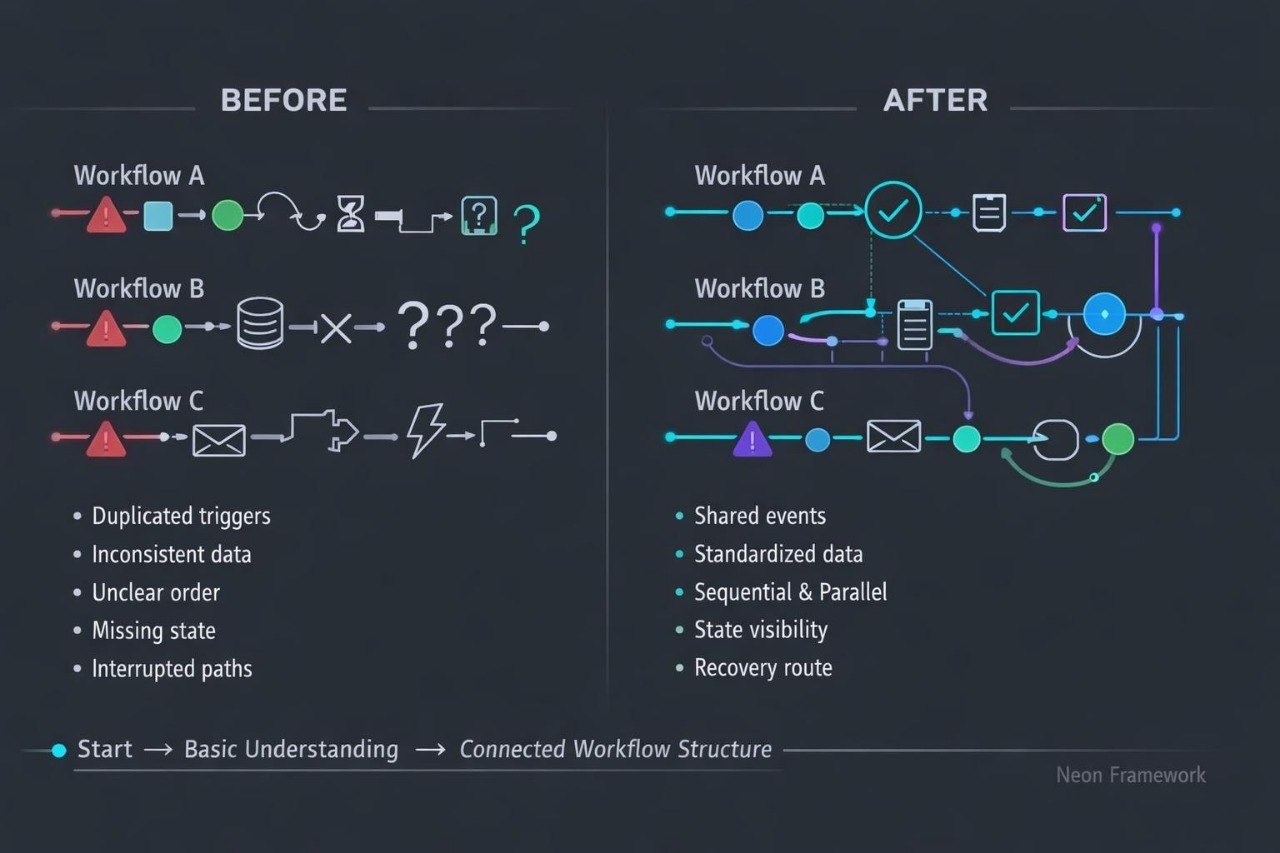
Struggling to maintain consistency when several automated workflows exchange information and trigger one another? You are not alone: individual scenarios may appear clear on their own but create conflicts when combined into one system. A single event may start several routes, information may arrive in different formats, and the execution order may become difficult to follow. Without a shared architecture, it can be unclear which workflow is responsible for an action and where the system state should be reviewed. Neon Framework helps learners describe interactions between workflows through shared events, rules, and control points.
2. Solution
This course will teach you how to design a system containing several connected AI workflows. You will examine how events start modules, how information moves between them, and how repeated execution can be reduced. The materials explain methods for coordinating parallel routes, handling delays, and recording system states. You will also learn how to define logging, review, and recovery rules for interrupted processes. The final activity involves preparing an architecture diagram containing several workflows, shared information, and documented interaction rules.
3. What’s Inside
Module 1: Connected Workflow Architecture
Identify the central processes, their responsibilities, boundaries, and shared interaction points.
Module 2: Events and Start Rules
Describe events that begin, pause, continue, or close individual workflow routes.
Module 3: Information Contracts
Define structure, naming, formatting, and validation rules for information exchanged between modules.
Module 4: Sequential and Parallel Routes
Study when actions should occur in order and when several branches may operate at the same time.
Module 5: Coordinating Workflow Outcomes
Determine how the system collects results from several routes and decides when the following stage can begin.
Module 6: Repeated Event Identification
Identify duplicate triggers and create rules that reduce repeated operations.
Module 7: State Records
Design records showing the current stage, received information, completed actions, and reasons for each transition.
Module 8: Delays and Interrupted Routes
Describe how the system responds when information arrives late or one workflow stops before completion.
Module 9: Interaction Review
Prepare test scenarios for the central route, parallel actions, repeated events, and irregular situations.
Module 10: Final Neon Architecture
Create a complete diagram containing several workflows, events, information contracts, state records, and coordination rules.
4. Who Is This For?
✅ Suitable if you:
- have created modular and branched workflow diagrams;
- want to connect several processes within one system;
- work with parallel routes and event-based logic;
- want to document information movement more clearly;
- are prepared to examine system behavior across different states.
❌ Not for you if you:
- are beginning with basic workflow concepts;
- have not worked with conditions, modules, or dependencies;
- want a brief overview without a final activity;
- need a ready-made configuration for one organization.
5. What You’ll Learn
- Design a system containing at least three connected workflows.
- Document starting and closing events for every route.
- Create information contracts for exchanges between modules.
- Separate sequential actions from parallel operations.
- Define rules for collecting workflow outcomes.
- Reduce repeated execution of the same operation.
- Create records for at least five system states.
- Describe system behavior during delays and interruptions.
- Prepare a collection of six interaction test scenarios.
- Build a complete Neon Framework architecture map.
6. Refund Terms
Neon Framework includes a 30-day period for submitting a refund request. Requests are reviewed under the terms published on the Orqivo website, including the purchase date, completed material, and other stated provisions.
7. Certificate
After completing the required modules and submitting the final architecture diagram, learners may receive an Orqivo certificate. It records the Neon Framework title and completion of the assigned learning program.
1. What experience level are the courses designed for?
1. What experience level are the courses designed for?
The materials are structured to help learners study AI Workflow Automation in a logical sequence. Each tier has its own scope, topics, and level of detail, allowing learners to select a format that matches their current knowledge and learning goals.
2. How are the course materials presented?
2. How are the course materials presented?
Courses may include structured lessons, topic-based modules, written explanations, workflow examples, practice activities, and resources for independent study. The specific contents are listed in the description of each tier.
3. Do I need to install additional tools?
3. Do I need to install additional tools?
The courses focus on process logic, automation planning, and workflow structure. When an activity requires an additional tool, the relevant information will be provided within the course materials.
4. Is a certificate included?
4. Is a certificate included?
A certificate of completion may be provided after the required modules and assigned activities have been completed. It records completion of an Orqivo learning program but does not represent a professional license or government-issued qualification.
Share